Why Increasing Your Marketing Budget Won’t Fix a Poor Customer Journey
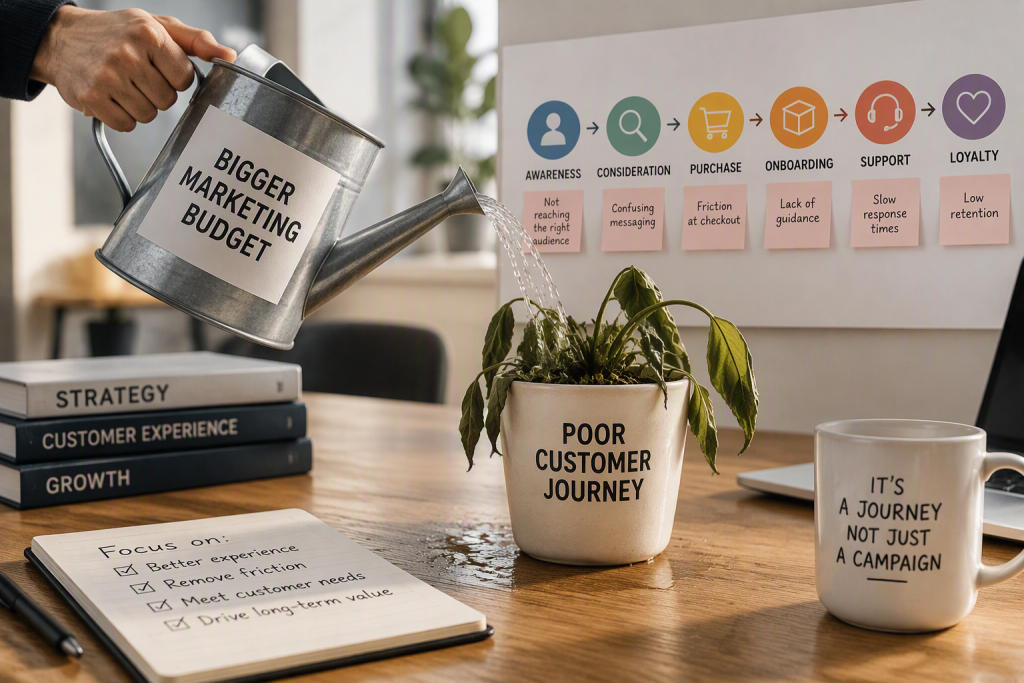
Customer journey optimisation helps businesses improve every stage of the path from first discovery to purchase. If your website, messaging, checkout or follow-up process is not converting effectively, increasing spend simply sends more people through the same experience.
Takeaway: More traffic creates more opportunity when the journey works. When the journey is weak, more traffic creates more wasted spend.
Many businesses assume growth is a traffic problem. When sales slow down, the first response is often to increase advertising budgets, launch more campaigns or reach more people.
But marketing performance is not created by one channel in isolation. Every interaction between a customer and a business contributes to the final decision.
A customer journey includes the first search, the first impression, the website experience, the decision-making process, the purchase and what happens afterwards.
The customer journey starts before someone reaches your website
The customer journey begins before someone clicks a link. People discover businesses through multiple touchpoints, often moving between channels before they are ready to buy.
This could include Google search, social media, recommendations, AI discovery tools, email campaigns or marketplaces. Each interaction shapes expectations before the website visit even happens.
Growth happens when every stage connects together.
Search, social, recommendations, AI, email and marketplaces.
The customer recognises a need and explores possible solutions.
They compare options, evidence and trust signals.
The experience needs to answer questions quickly.
The relationship continues beyond the first purchase.
More traffic does not solve conversion problems
A larger advertising budget increases the number of people entering your journey. It does not automatically improve the percentage of people who progress through it.
Small improvements across the journey can double commercial results.
£5,000 advertising spend
10,000 visitors
1% conversion rate
100 sales
£5,000 advertising spend
10,000 visitors
2% conversion rate
200 sales
Your website is part of your marketing, not separate from it
Your advertising creates the opportunity, but your website determines what happens next.
Businesses should ask whether landing page messaging matches the advert, whether the value proposition is obvious, whether users can find information quickly, whether trust signals are visible, whether mobile experience is strong and whether calls to action are clear.
Your product and service pages are salespeople
Every page needs to answer the questions a customer has: What is it? Why should I choose it? Why trust this business? What happens next?
Checkout friction quietly loses revenue
Small barriers can stop customers completing a purchase, including unexpected costs, limited payment options, account creation requirements, unclear delivery information, poor reassurance and complicated checkout journeys.
The customers who don’t buy still have value
Not every visitor converts immediately. Email capture, abandoned basket recovery, remarketing and nurture campaigns help businesses continue conversations with interested customers.
Advertising works best when every channel learns together
Google Ads learns from conversion quality. Email learns from behaviour. Paid social learns from audiences. Analytics connects everything together.
Customer journey optimisation checklist
Successful marketing is not created by increasing activity in one channel.
It comes from improving the complete journey connecting Awareness → Consideration → Conversion → Retention.
Related Dancing Badger services.
Improve this part of your digital growth journey.
ServiceEcommerceImprove this part of your digital growth journey.
ServiceConversion Rate OptimisationImprove this part of your digital growth journey.
ServicePPCImprove this part of your digital growth journey.
ServicePaid SocialImprove this part of your digital growth journey.
ServiceEmail MarketingImprove this part of your digital growth journey.
ServiceData AnalysisImprove this part of your digital growth journey.
ServiceGrowth StrategyImprove this part of your digital growth journey.