Why More Marketing Activity Doesn’t Always Mean More Growth
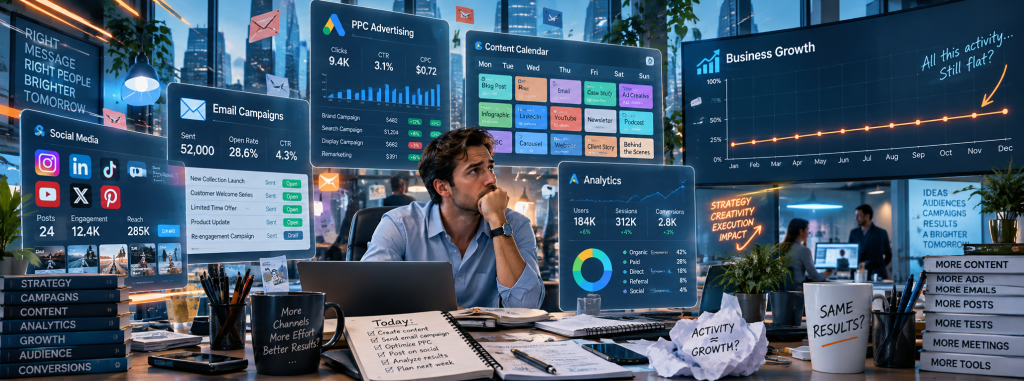
Digital marketing growth rarely comes from simply adding more activity. Most businesses already have more channels, platforms and tactics available to them than they could realistically use.
They can invest in SEO, Google Ads, paid social, email marketing, content, social media, ecommerce, website improvements and a growing number of AI and automation tools.
The natural response when growth slows is often to add something else.
Another campaign. Another channel. Another platform. Another budget line.
But more activity does not automatically create more growth.
This is one of the patterns we have seen repeatedly while working across websites, search, paid media, ecommerce, email and analytics.
A business can have a strong SEO programme, well-managed paid campaigns, regular email activity and an attractive website — yet still struggle to generate the level of enquiries, sales or customer value it expects.
Individually, every channel may appear busy. Some may even appear successful.
The problem begins when each channel is planned, measured and optimised as if the others do not exist.
More marketing doesn’t automatically create more growth
Digital platforms encourage us to think vertically.
Google Ads reports on Google Ads. Meta reports on Meta. Search tools report on rankings and visibility. Email platforms report on opens, clicks and attributed revenue. Analytics platforms try to bring the journey together, but even they are working with incomplete signals.
This makes it very easy for each discipline to become its own mini business case.
SEO wants more organic visibility. PPC wants a stronger return on ad spend. Social wants more reach or engagement. Email wants more revenue from the database. The website team wants better conversion. Ecommerce wants more sales.
None of those goals is wrong.
But they become much more useful when they sit underneath a shared commercial objective.
The same channels can create very different outcomes.
Each channel can improve its own dashboard while the customer journey between them remains unchanged.
The channels still have specialist roles, but decisions are made using information from the wider system.
This is why our approach to Growth Strategy starts above the individual channel.
Before deciding whether the answer is more SEO, more paid media, a new website or a different customer journey, the first question should be what the business is actually trying to change.
More qualified enquiries? More first-time customers? Higher repeat purchase? Better margin? Greater share in a particular market? More revenue from existing traffic?
Once that is clear, each channel can be given a role rather than simply a budget.
Your customer does not know which marketing budget introduced them to your business. They experience one brand, one journey and one decision.
Your customers don’t experience your marketing in channels
A real customer journey is rarely as simple as “clicked an advert, bought a product”.
Someone might discover a business through an unbranded Google search, visit the website, leave, see a Meta advert a few days later, return directly, read a case study, join an email list and eventually convert after searching for the brand by name.
Which channel created the customer?
The useful answer is often not one channel. It is the combination.
That becomes especially important for businesses with longer consideration periods, higher-value purchases or repeat customer relationships.
A typical conversion can cross several channels before the customer acts.
An unbranded query introduces the customer to the business.
The visitor explores services, products, proof and expertise.
A later campaign keeps the brand visible and reinforces relevance.
A case study, guide or insight answers a question and builds confidence.
Follow-up content or automation moves the relationship forward.
The customer enquires, buys, books or returns to purchase again.
This does not mean attribution is useless. It means attribution needs context.
It is one reason our Data Analysis work and DB Analytics focus on giving businesses a broader commercial view rather than relying on one advertising platform’s version of success.
It also changes how channels should be managed.
Search terms from PPC can help shape SEO and website copy. High-performing organic content can become paid creative. Ecommerce purchase behaviour can improve audience targeting. Email engagement can reveal which products or messages deserve more attention elsewhere.
The more information moves between disciplines, the less each channel has to learn in isolation.
Your website is where your marketing channels meet
Businesses often try to solve an acquisition problem by buying more acquisition.
More impressions. More clicks. More traffic.
But if the website is unclear, slow, difficult to use or poorly matched to the intent of the visitor, every additional click arrives at the same problem.
That makes the website one of the most important shared assets in a joined-up marketing system.
SEO sends people there. PPC sends people there. Social campaigns send people there. Email sends people back there. Brand activity changes what people expect when they arrive there.
Different acquisition channels often meet at the same website experience.
Message match, usability, trust, product or service clarity, landing pages, forms, checkout, speed and conversion.
Sometimes the most effective way to improve a paid campaign is therefore not to change the campaign at all.
It may be to improve the landing page through Conversion Rate Optimisation, strengthen the proposition, reduce friction in a form, simplify a checkout journey or make the information people need easier to find.
For an ecommerce business, that might mean improving product discovery, navigation and merchandising through a better ecommerce experience.
For a service business, it might mean changing the structure and messaging of a website so that traffic arriving from different campaigns has a clearer route to enquiry.
A website improvement can therefore be a marketing improvement even though it does not sit inside an advertising platform.
Marketing platforms only show part of the picture
Advertising and marketing platforms are built to show the value they create.
That is understandable. It is also why businesses can end up with several dashboards apparently claiming credit for the same commercial outcome.
Google may attribute a conversion to paid search. Meta may report that the customer converted after seeing or clicking an advert. An email platform may assign revenue to a campaign. Analytics may record the final session as direct or organic.
None of those views is automatically false. They are simply answering slightly different questions using different attribution rules, tracking methods and available signals.
Platform reporting is useful. It is not the same thing as the whole commercial picture.
Search and advertising data can show demand, intent, clicks and attributed conversions inside Google’s measurement model.
Meta
Campaign reporting can show how audiences interact with paid social and how conversions are attributed after those interactions.
Commercial reality
Orders, qualified leads, margin, repeat customers, territory performance and total revenue show what actually happened to the business.
This is where joined-up reporting becomes as important as joined-up delivery.
A business needs to understand not only which channel appears to be performing, but how total marketing activity is changing the number and quality of customers it acquires.
That may mean looking at new versus returning visitors, new versus returning customers, assisted journeys, geographic performance, lead quality, lifetime value or revenue by customer group.
Better measurement does not eliminate uncertainty.
It gives the business enough evidence to make the next decision with more confidence.
What connected digital marketing growth looks like
The biggest benefit of integrated digital marketing is not simply consistency.
It is learning speed.
When teams and channels share information, one activity can make another smarter.
Search data reveals what people want. Paid media can test which messages create response quickly. Website analytics shows what people do after the click. Audience and segmentation work identifies important differences between customer groups. Email reveals what keeps people engaged after the first conversion.
Those findings should then feed back into the next round of decisions.
Connected marketing gets smarter because the learning travels.
Use search, market, customer and competitor signals to identify where real opportunity exists.
Use SEO, PPC, social, content and targeting according to the role each channel should play.
Make the website, landing page, product journey or enquiry path match the visitor’s intent.
Track meaningful actions, customer quality, revenue and behaviour rather than stopping at clicks.
Use customer behaviour to create more relevant email, remarketing and retention journeys.
Use what worked — and what did not — to change budgets, messaging, targeting and priorities.
This is also why a full-service digital marketing approach should not mean automatically using every available service.
It means having enough visibility across the system to identify where the next improvement should happen.
Sometimes that is search visibility. Sometimes it is paid acquisition. Sometimes it is conversion. Sometimes it is retention. Sometimes the most useful step is simply fixing the measurement before changing anything else.
The technology behind connected digital marketing
Modern digital marketing depends on a growing technology stack.
Advertising platforms manage targeting and media. Ecommerce platforms handle buying journeys. Email tools manage automation and retention. Analytics and market-intelligence tools help explain what is happening. Consent technology affects what can be measured in the first place.
The value is not in collecting as many platforms as possible.
It is in choosing the right ones and making sure information can move between them.
The tools should support the customer journey, not dictate it.
Search demand, paid acquisition, shopping, analytics and measurement.
Paid social MetaAudience-led advertising, prospecting, remarketing and social commerce.
Ecommerce ShopifyStorefront, checkout, product data and connected ecommerce journeys.
Retention & automation KlaviyoBehaviour-led email, segmentation, automation and repeat-purchase journeys.
Consent & measurement CookiebotConsent management that supports compliant, more reliable measurement.
Market intelligence SimilarwebMarket, competitor and audience signals used to add context to performance data.
Search intelligence SE RankingSearch visibility, competitor monitoring and SEO performance insight.
Local search BrightLocalLocal visibility, listings and location-level search performance.
The important word here is connected.
A sophisticated technology stack with no shared strategy can create more dashboards without creating better decisions.
A simpler stack, properly integrated around the commercial objective, is often much more valuable.
This is also where third-party integrations can become important: not because integration is technically impressive, but because the right data moving between the right systems can improve customer experience, targeting and reporting at the same time.
Start with the commercial objective, not the marketing channel
A joined-up strategy does not have to begin with a huge transformation project.
In many cases, the first step is simply changing the order of the questions.
Instead of asking, “Should we spend more on Google Ads?” start with, “What commercial result are we trying to improve?”
Instead of asking, “Do we need more traffic?” ask, “Do we have enough of the right traffic, and what happens after it arrives?”
Instead of asking, “Which channel has the best ROAS?” ask, “Which combination of activity is creating the customers we most want?”
How to identify where your marketing is holding growth back
Once the commercial objective is clear, the next job is to identify the part of the journey that is restricting progress. The weakest point may be visibility, targeting, proposition, website experience, conversion, retention or measurement.
This is where a connected view becomes useful: rather than asking every channel to work harder, you can focus attention on the constraint most likely to change the outcome.
A simple connected-growth review
That approach often leads to a different marketing plan.
The answer might still be to invest more.
But it might be to redirect existing spend, improve a landing page, change the audience, build a better email journey, fix tracking, sharpen the proposition or stop an activity that no longer has a strong commercial case.
Doing more is only valuable when more is the thing the business actually needs.
Sometimes growth comes from doing less, not more
A stronger strategy does not always add another campaign, platform or piece of technology. Sometimes the better decision is to concentrate budget on the activity producing the strongest customers, simplify an overcomplicated journey or stop work that no longer has a convincing commercial case.
Reducing activity can improve focus, make measurement clearer and give the parts that are working enough budget and attention to perform properly.
Build your marketing around growth, not activity
The goal is not to make every marketing channel busier. It is to create a system in which strategy, acquisition, website experience, conversion, retention and measurement all support the same commercial objective.
That is the real distinction between doing more digital marketing and creating sustainable digital marketing growth.
Growth does not come from the number of channels you use. It comes from how well the right ones work together.
Start with the commercial outcome, understand the customer journey, connect the data and focus investment on the part of the system most capable of changing the result.
At Dancing Badger, that is increasingly how we think about digital growth.
SEO, PPC, social media, email, websites, ecommerce and analytics remain specialist disciplines. Each requires its own expertise.
But the commercial value increases when those specialists can see beyond their own channel.
A search insight should be able to improve a landing page. A customer segment should be able to change an advertising strategy. A conversion problem should influence media spend. A successful campaign should teach the wider business something about what its customers actually value.
That is the difference between a collection of marketing activities and a growth system.