How AI Image Creation Is Affecting Traditional Photographic Studios
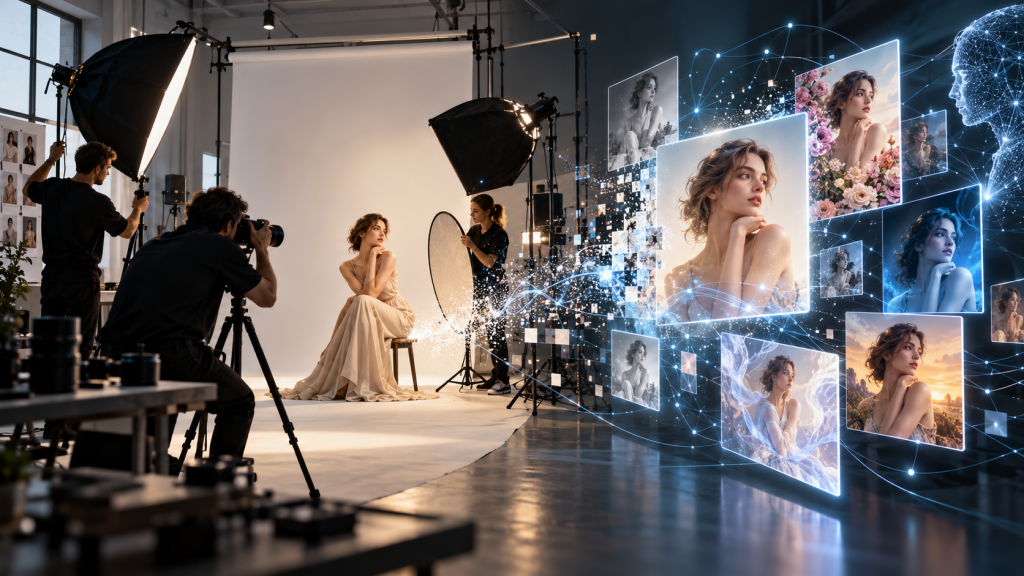
Artificial intelligence has moved quickly from being a novelty creative tool to a serious part of the commercial image-making process. What once required a physical studio, lighting setup, props, models, post-production time and multiple rounds of editing can now, in some cases, be created or adapted using AI image generation.
For traditional photographic studios, this is creating both disruption and opportunity. The change is not only technical. It is commercial. Clients are asking different questions, comparing different production routes and rethinking what should be photographed, what can be generated and what can be done as a hybrid of the two.
The result is a more complicated market for commercial imagery. In lower-complexity use cases, AI can reduce cost and speed up asset production. In higher-trust or higher-accuracy categories, original photography remains difficult to replace. The most important point is that the value of a studio is no longer defined by image capture alone. It increasingly sits in visual judgement, workflow design, consistency, brand understanding and the ability to decide which production method is actually right for the job.
AI image creation is changing the economics of commercial imagery
The biggest improvement in AI image creation is realism. Early AI-generated images were often easy to identify, with strange hands, distorted faces, unrealistic lighting and visual inconsistencies. Today, the technology is far more sophisticated. AI tools can create product-style scenes, lifestyle setups, fashion concepts, campaign backdrops, textures and visual variations with a much greater level of polish.
They can also extend existing images, remove unwanted objects, change backgrounds, alter lighting and produce multiple outputs from a single original asset. That matters because much of the day-to-day demand for commercial imagery is not about one hero image. It is about volume: multiple crops, multiple seasonal versions, multiple placements, multiple campaigns and multiple channels.
This directly affects photographic studios because many brands are now questioning whether they need a full physical production for every piece of content. For ecommerce, social media and campaign mock-ups, AI can often produce usable visuals faster than a traditional shoot. A product that once needed several styled setups may now need only one accurate source image and a carefully controlled enhancement workflow.
The market is shifting from fully physical production to a wider mix of studio, hybrid and AI-led workflows.
Physical set, lighting, props, photographer, styling and retouching. Best when accuracy, control and authenticity are essential.
Real source imagery is captured first, then backgrounds, extensions, variations or edits are produced more efficiently using AI tools.
Useful for concepts, exploratory visuals, mock-ups, simple campaign assets and lower-risk production where exact realism is less critical.
Product photography is one of the most affected areas. Standard pack shots, simple lifestyle scenes and background changes can increasingly be handled through AI-assisted workflows. That creates pressure on studios that rely heavily on repeatable, lower-complexity commercial work, because the perceived value of that work shifts from effort to outcome.
AI does not just compete with photography on creativity. It competes on speed, flexibility and the ability to produce more image variations from fewer original assets.
Studios built around routine asset production are likely to feel the change fastest
The areas under most pressure are the ones where image requirements are predictable and repeatable. If a client previously booked a studio for simple cut-outs, catalogue-style shots, background swaps or a large number of minor creative variations, AI may now offer part of that output with less time and lower production friction.
This does not mean the end of studio work. It means the low-complexity end of the market is becoming more contestable. The client who once paid for three shoot days may now pay for one day of source capture followed by an AI-supported production workflow. The studio still has a role, but the shape and pricing of that role changes.
Not every studio service is affected in the same way.
Routine commercial production
Work based on repeatability and volume is most exposed to AI substitution or hybrid production models.
- Basic pack shots and cut-outs
- Simple background changes
- Fast social content variations
- Large-volume marketplace imagery
Campaign and brand content
AI can support concepting and asset expansion, but strong art direction and brand consistency still matter.
- Ad mock-ups and exploratory concepts
- Versioning for multiple channels
- Visual testing before a full shoot
- Hybrid production for faster rollout
Authenticity-led photography
Some categories still depend on real-world credibility, especially where trust and accuracy drive conversion.
- Real spaces, people and teams
- High-trust product categories
- Luxury, hospitality and property imagery
- Proof-led brand storytelling
Real products, real spaces and real trust still matter
However advanced image generation becomes, many commercial use cases still depend on original assets. A product often needs to be photographed accurately. Materials, scale, colour, finish and texture have to be represented properly. In sectors such as fashion, furniture, interiors, hospitality, jewellery, beauty and luxury retail, poor or misleading imagery can weaken trust, increase returns and damage brand credibility.
There is also the issue of authenticity. Audiences are becoming more aware of artificial visuals, and brands need to think carefully about when AI is appropriate. In some sectors, customers want to see the real product, the real premises, the real team or the real experience before they commit. A generated approximation may look polished while still failing commercially because it does not answer the customer’s underlying trust question.
That is one reason why photography still matters so much in website design, conversion rate optimisation and ecommerce. Good imagery is not only decorative. It helps visitors decide whether the product is right, whether the brand feels credible and whether the offer is believable.
Four reasons original photography keeps its value.
Shape, colour, scale, finish and texture often need to be shown truthfully, especially where buying decisions depend on detail.
Customers often respond better to imagery that feels credible and evidenced rather than merely impressive.
Lighting, styling, composition and visual language still need to be managed so assets feel cohesive across campaigns and channels.
Many brands benefit from having their own source library that can be used across web, print, social and paid media.
The most resilient studios will sell judgement, direction and workflow design – not just camera time
This is where traditional studios still have a clear advantage. They understand lighting, composition, colour accuracy, styling, art direction and brand consistency. They know how to make a product feel desirable, not merely visible. AI can generate an image, but it does not automatically understand the commercial purpose behind it.
That creates a new opportunity for studios willing to adapt. Instead of selling only image capture, they can position themselves as image-production partners. That role can include photography, AI-assisted editing, digital set creation, image versioning, retouching, campaign concepting and content production for multiple platforms.
In practice, this means the studio of the future may look less like a place where every asset is made from scratch and more like a place where visual systems are designed. A single shoot can feed website imagery, social media versions, paid social creatives, print collateral, marketplaces and internal brand libraries. AI then becomes part of the workflow rather than an external threat.
Studios that can connect real photography with wider digital workflows may become more valuable, not less. They are able to give clients a controlled visual starting point and then help expand it intelligently across channels.
The competitive advantage is shifting from taking the picture to designing the visual production system around the client’s commercial goals.
AI-generated imagery introduces practical, legal and brand risks
There are also important limitations and risks with AI-generated imagery. Copyright, licensing and originality are not always straightforward. Businesses need to understand what tools they are using, what data models may have been trained on and whether generated assets are suitable for commercial use.
There are brand risks too. If an image exaggerates what a product looks like, invents details that are not there or creates an environment that misrepresents the customer experience, the cost can show up later in weaker trust, higher returns or poorer conversion performance. Visual efficiency is not useful if it undermines the credibility of the brand.
This is especially relevant for businesses selling online through platforms such as Shopify or running acquisition campaigns via Google and Meta. In those channels, imagery is directly connected to click-through rate, product understanding and on-site conversion. The image does not just need to look good. It needs to perform honestly.
When is AI a strong option – and when should a studio lead?
- Speed matters more than perfect realism You need concept visuals, mock-ups, campaign ideas or rapid content expansion.
- You already have strong source assets AI can help create variations, extensions and edited versions from real original imagery.
- The use case is low-risk The content supports marketing exploration rather than proving a product or space exactly as it is.
- Volume is the challenge Multiple formats, seasonal variants and channel-specific crops can be produced more efficiently.
- Accuracy affects buying decisions Products, finishes, dimensions and environments need to be represented truthfully.
- Authenticity is part of the value Customers need to see the real people, real place or real experience behind the brand.
- The brand carries higher risk Luxury, property, hospitality and premium ecommerce often depend heavily on trust and perceived quality.
- You need an original visual library Bespoke photography creates assets the brand fully controls across website, social, print and campaign use.
Adaptation is more realistic than resistance
For traditional photographic studios, the challenge is not simply that AI can create images. The challenge is that client expectations are changing. Businesses now want more content, faster turnaround times, more versions and less production friction. Studios that only sell time behind a camera may feel under pressure. Studios that sell creative judgement, brand understanding, workflow design and production expertise are better placed to thrive.
One practical route is to build clearer hybrid offers. That might mean shooting core assets physically, then offering AI-assisted background creation, colourway exploration, concept boards, campaign mock-ups or versioning for different platforms. Another is to package work around outcomes instead of production hours: content libraries, launch kits, product roll-out systems or multi-channel asset creation for web and advertising.
Studios can also benefit from connecting their work more clearly to brand and performance. Strong visual assets support branding, ecommerce, organic visibility, ad performance and on-site conversion. When that connection is made explicit, photography stops being seen as an isolated cost and starts being understood as part of the wider commercial system.
This is also where better reporting helps. Through clearer data analysis and tools like DB Analytics, businesses can evaluate whether changes in imagery affect engagement, click-through rates, conversion and revenue. That creates a more useful conversation than the simple question of whether AI is cheaper.
AI is not the end of photography, but it is changing what clients value. The future is likely to belong to studios that combine real-world photographic skill with intelligent AI use. The camera still matters, but the studio of the future will also need to be as confident with prompts, editing tools and digital production systems as it is with lenses, lighting and composition.
The market is not choosing between photography and AI. It is deciding when each one creates the strongest commercial result.
For some jobs, AI will reduce the need for traditional studio production. For others, real photography will remain the only credible option. The studios most likely to grow are the ones that understand both sides of that equation and can guide clients towards the right visual production model rather than defending the old one by default.
If you want to extend this article into a wider content cluster, useful related angles include AI-assisted content production, visual brand consistency, ecommerce conversion imagery, digital asset workflows and the role of original photography in building trust online.