

Why Retargeting Campaigns Are Essential for Maximising Website Conversion Rates
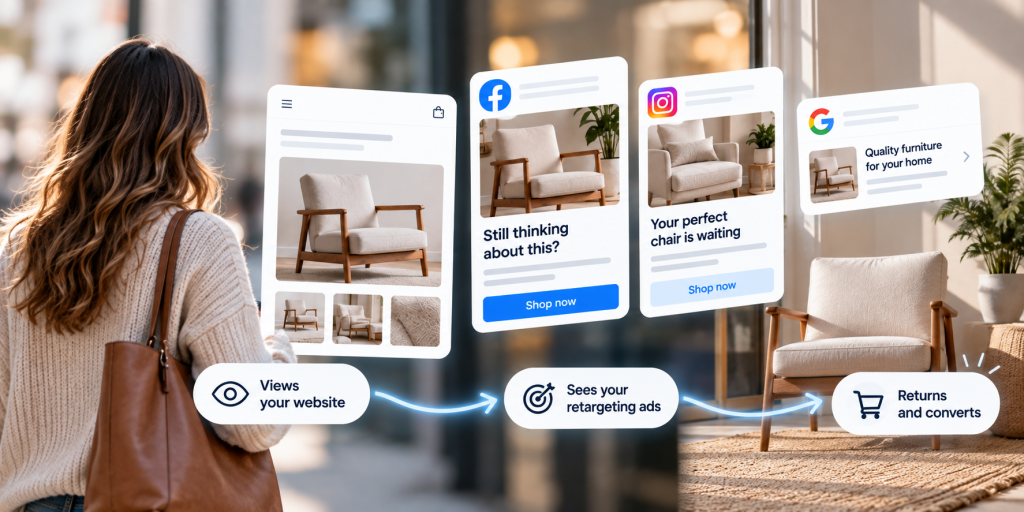
Not every customer converts the first time they visit your website. Many people browse, compare options, read reviews, look at pricing, view products, add items to a basket or visit important service pages before leaving without taking action. That does not necessarily mean they are not interested. Often, it simply means they are still considering their options.
This is where retargeting campaigns become valuable. Retargeting allows businesses to re-engage people who have already interacted with their website, brand, products or content. Through platforms such as Google and Meta, businesses can create audiences based on previous behaviour and show relevant advertising to people who already recognise the brand.
Compared with completely cold advertising, retargeting starts with an important advantage: some form of previous interaction has already taken place. The user may have viewed a product, read a service page, explored pricing, clicked a call to action or started a checkout. That previous behaviour provides useful context for deciding what message should come next.
The purpose is not simply to follow somebody around the internet with the same advert. Good retargeting is more considered than that. It uses audience behaviour, timing, creative and message relevance to give potentially valuable visitors another reason to return when they are ready to take the next step.
The first visit often creates interest rather than an immediate conversion
Websites are frequently judged by the number of visitors who convert during their first session, but that can oversimplify the way people make decisions. Many purchases and enquiries require more than one interaction. Customers may want to compare alternatives, check reviews, discuss the decision with somebody else or simply wait until the timing is right.
This is especially true for higher-value products, professional services, considered purchases and businesses where trust plays an important role. A visitor can be genuinely interested without being ready to fill in a form or complete a transaction at that moment.
Without retargeting, the business may rely entirely on that person remembering the brand, returning through search or navigating back later on their own. Retargeting creates another route back into the journey.
Used well, this supports both PPC and paid social activity because the advertising strategy can distinguish between attracting new visitors and reconnecting with people who have already shown some level of interest.
Retargeting creates another opportunity between the first website visit and the final decision.
A user discovers the website through search, advertising, social media, a referral or another marketing channel.
They view a product, explore a service, visit pricing, add something to a basket or complete another meaningful action.
Retargeting keeps the brand visible with advertising that reflects the user’s earlier behaviour and stage in the journey.
The visitor comes back with greater familiarity and another opportunity to enquire, buy, book or take the next step.
Previous behaviour gives you more context for the next message
One of the biggest benefits of retargeting is that it focuses on an audience that already knows something about the business. These users have moved beyond complete unfamiliarity. They may recognise the brand, understand the proposition or already know the particular product or service they are interested in.
That does not mean every previous visitor is automatically valuable. Someone who accidentally reached a page and left immediately should not necessarily receive the same attention as someone who repeatedly viewed a product or started an enquiry.
The advantage comes from using behaviour to identify different levels of intent. A visitor who reads an educational article may still be early in the research stage. Someone who views pricing or checks delivery information may be further along. Someone who begins checkout or starts completing a lead form may be showing much stronger intent.
This allows campaign strategy to become more relevant. Rather than continually asking every visitor to “buy now” or “get in touch”, businesses can tailor the message to the stage the visitor appears to be in.
Previous interaction gives marketers four useful advantages.
The brand is no longer completely new
Previous visitors may already recognise the business, reducing some of the initial uncertainty associated with a first interaction.
Behaviour provides useful signals
Product views, service-page visits, basket activity and other actions can indicate what somebody is interested in.
Messaging can be more specific
Creative can respond to the part of the journey the visitor has already reached instead of restarting with generic awareness messaging.
Existing traffic gets another opportunity
Retargeting helps businesses continue working with traffic they have already generated rather than relying solely on finding new visitors.
The retargeting opportunity changes depending on what the website is trying to achieve
For ecommerce websites, retargeting can be particularly useful because visitor behaviour often provides strong clues about product interest. Somebody may browse a category, repeatedly view one item, add a product to their basket or begin checkout without completing the purchase.
Where the platform, consent setup and available data support it, product-led retargeting can reconnect that visitor with relevant products or ranges. The messaging might focus on the exact product they considered, useful delivery information, customer reviews, returns reassurance or another factor that helps reduce hesitation.
Lead-generation businesses have a different journey. Someone may read several service pages, visit the team page, review a case study or begin completing an enquiry form before leaving. In that situation, the most useful retargeting message may be less about urgency and more about expertise, reassurance and trust.
A visitor considering a professional service could be shown content that reinforces the business’s experience, highlights a relevant case study or brings them back to a focused landing page. This is where retargeting can work particularly well alongside website design and conversion rate optimisation. The advert brings the person back, but the website still needs to convert the renewed interest.
Ecommerce and lead-generation audiences often need different reasons to return.
Retargeting becomes more useful when the advert reflects what the visitor has already done instead of repeatedly showing everybody the same generic message.
Not every visitor is ready to buy at the same point
Retargeting is valuable because it recognises that customers move through different stages of consideration. Some are still discovering the problem they need to solve. Others are comparing suppliers, reviewing products or waiting until they have the budget, time or internal approval required to move forward.
A single website visit cannot always resolve that entire journey. Paid social retargeting can help keep a brand visible while customers continue considering their options, while search and display activity can support later stages where users are still researching or returning to relevant categories.
The key is to avoid treating every stage as though conversion should happen immediately. Earlier-stage audiences may respond better to helpful content, demonstrations, customer stories or useful guides. Higher-intent users may need pricing clarity, delivery information, reassurance or a stronger call to action.
This makes retargeting part of a wider growth strategy. Rather than judging every advert only by immediate conversion, businesses can use different campaign layers to support the progression from awareness to consideration and finally to action.
Retargeting helps make previous marketing activity work harder
Another advantage is improved marketing efficiency. Driving new visitors to a website can be expensive, particularly in competitive markets. Businesses invest in SEO, paid search, paid social, content, email, partnerships and other activity to generate traffic.
Not every one of those visits will create an immediate outcome. Retargeting gives some of that existing audience another opportunity to return rather than treating every non-converting session as a dead end.
This is important because acquisition and conversion should not be viewed as completely separate problems. A business can continue increasing advertising spend to generate more traffic, but if useful visitors repeatedly disappear after one session, improving the follow-up journey may be a more efficient opportunity.
That does not mean retargeting should replace customer acquisition. Businesses still need new audiences. The stronger approach is usually a balance: prospecting activity introduces the brand to relevant new people, while retargeting helps continue the conversation with those who show genuine interest.
Strong retargeting audiences are built around meaningful differences in intent
One of the biggest mistakes in retargeting is creating one large audience containing everybody who has visited the website and then showing all of them the same advert.
A visitor who read one blog article is not necessarily in the same position as somebody who viewed a service page several times. A product browser is not the same as a basket abandoner. A previous customer may need completely different messaging from somebody who has never converted before.
Segmentation makes the advertising more relevant. It allows businesses to create audiences based on behaviour and decide what each group is most likely to need next.
Different website behaviours can justify different messages.
Content readers
These users may still be researching and could benefit from useful educational or problem-solving content.
- Keep messaging helpful rather than overly sales-led
- Introduce relevant services or deeper content
- Build familiarity gradually
Service-page visitors
These users have shown interest in a defined area of the business and may need stronger proof before enquiring.
- Use relevant case studies
- Highlight testimonials or expertise
- Return users to the relevant service
Product viewers
Product interest can support more specific creative around the items or categories somebody has already explored.
- Reinforce key product benefits
- Use reviews or reassurance
- Keep the route back to purchase simple
Basket abandoners
These visitors have moved further into the buying journey and may need help overcoming the final barriers to purchase.
- Address delivery and returns concerns
- Provide relevant reassurance
- Avoid unnecessary distractions
Form starters
Someone who started an enquiry may be interested but uncertain, interrupted or not yet ready to complete it.
- Strengthen trust
- Offer alternative contact routes
- Reduce unnecessary form friction
Previous converters
Customers should usually be treated differently from unconverted prospects and can often be excluded from acquisition messaging.
- Consider repeat-purchase opportunities
- Promote genuinely complementary offers
- Exclude them when the original objective is complete
Retargeting should remind and persuade, not make the brand feel unavoidable
It is equally important to manage frequency. The fact that somebody visited a website does not mean they want to see the same advert repeatedly for weeks afterwards.
Excessive repetition can create creative fatigue and weaken brand perception. Instead of making a business feel relevant, it can make the advertising feel intrusive or stale.
Campaigns should therefore be monitored for frequency, audience size and creative performance. Advertising should also evolve as the audience moves further away from the original website visit. A basket reminder may be appropriate shortly after a session but far less relevant weeks later.
Creative variation matters too. Different headlines, visuals, products, benefits, testimonials or calls to action can help campaigns remain useful rather than simply repeating the same message.
Strong retargeting stays visible without becoming repetitive.
The goal is not simply to generate more retargeting clicks
Retargeting should be measured against the commercial outcome it is meant to support. Depending on the campaign, that may include enquiries, sales, bookings, cost per acquisition, revenue or return on advertising spend.
Engagement metrics still have a role, but they need context. A high click-through rate is not especially useful if those users repeatedly return without taking meaningful action. Equally, a campaign with fewer clicks may still be valuable if those visits convert at a stronger rate.
Businesses should also remember that retargeting audiences are naturally different from cold audiences. Someone who has already visited the website may have converted later even without seeing another advert. This is why performance should be reviewed carefully rather than assuming every attributed conversion was created entirely by the retargeting campaign.
Combining advertising data with website analytics and tools such as DB Analytics can help provide a clearer picture of what users did before and after returning to the site.
Retargeting should be evaluated by what it contributes to the customer journey and commercial result.
Check whether the campaign is reaching enough of the intended audience without relying on excessive repetition.
Clicks and landing-page activity can show whether the message is creating enough interest to bring previous visitors back.
Measure enquiries, purchases, bookings or other meaningful outcomes rather than focusing only on advertising engagement.
Review cost per acquisition, revenue and wider return alongside the role retargeting played within the overall journey.
Modern retargeting also depends on responsible data and consent practices
Retargeting has become more complex as privacy expectations, browser behaviour and advertising platforms have evolved. Businesses should not assume that every website visitor can or should automatically become part of an advertising audience.
Audience creation and measurement may depend on the visitor’s consent choices, the technologies used on the website and the rules of the advertising platform. This means the wider tracking setup needs to be considered alongside campaign strategy.
A well-managed implementation should therefore connect website tracking, consent management, audience definitions and campaign reporting. Marketing teams and developers need to understand what data is being collected, what it is being used for and whether the resulting audiences are appropriate.
This is another reason why retargeting should be treated as part of a broader digital system rather than a standalone media tactic. Good campaign strategy depends on reliable tracking, sensible data governance and a website experience that deserves another visit.
A strong retargeting strategy starts with audience logic rather than simply switching the campaign on
Before building a retargeting campaign, it is worth deciding which behaviours genuinely matter. Which pages indicate buying or enquiry intent? How long is the typical customer decision cycle? Which users should be excluded? What message would actually help each audience make progress?
These questions help avoid broad, repetitive campaigns that spend money simply because an audience exists. They also make measurement easier because each audience and campaign has a clearer purpose.
Retargeting works because conversion is rarely a single-touchpoint decision
Ultimately, retargeting is valuable because it reflects how people actually make decisions. Customers often need several interactions before they are comfortable buying, enquiring or booking. They discover a brand, investigate the offer, compare alternatives, leave, return and gradually build enough confidence to act.
Retargeting helps businesses stay visible during that process. Used alongside Google and paid social campaigns, it can reconnect interested visitors with the products, services and evidence they have already shown an interest in.
But retargeting should not be judged in isolation. The strongest results come when advertising, audience segmentation, landing-page experience, tracking and conversion optimisation work together.
A well-planned retargeting strategy therefore does more than recover traffic that might otherwise disappear. It can help businesses maximise conversion opportunities, improve the efficiency of wider marketing activity and turn more valuable website visitors into customers over time.
Retargeting is not about chasing every visitor. It is about recognising valuable intent and giving the right people a relevant reason to return.
When audiences are segmented carefully, creative reflects real behaviour and the website delivers a strong return experience, retargeting becomes an important part of a joined-up conversion strategy rather than simply another advertising campaign.