
The Benefits of Custom Landing Pages for PPC Campaigns
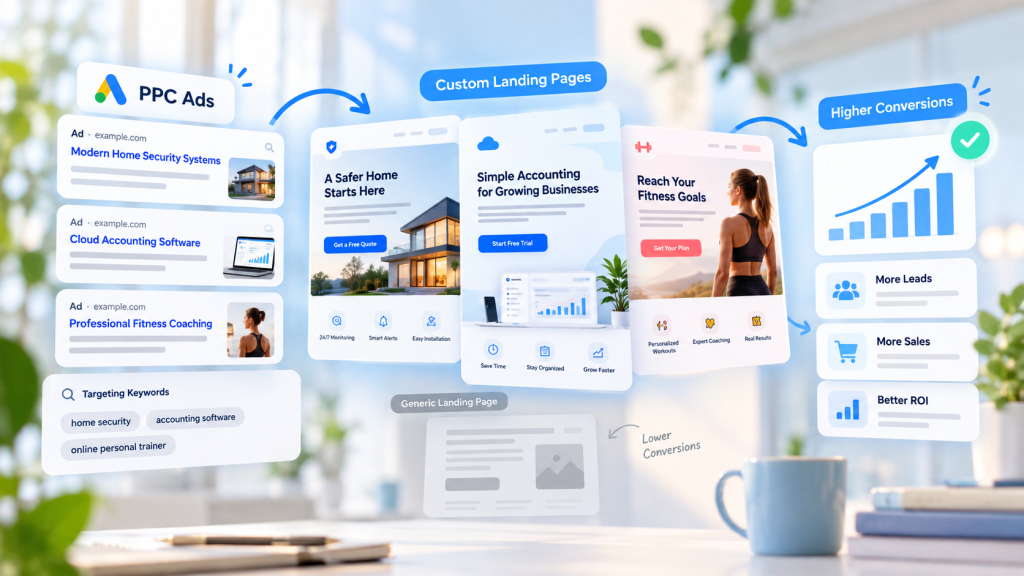
Pay-per-click advertising can be a highly effective way to drive targeted traffic to your website, but traffic alone does not guarantee results. The success of a PPC campaign depends on what happens after somebody clicks the advert. This is where custom landing pages can make a meaningful difference.
A custom landing page is a page built specifically for a campaign, audience, offer, product or service. Rather than sending users to a broad homepage or a general service page, the landing page is designed around the exact message, keyword theme and user intent behind the advert. That creates a far more focused journey and gives the campaign a better chance of turning clicks into action.
This matters because PPC is expensive when it is inefficient. If somebody clicks on an advert and then struggles to find the relevant information, feels uncertain about what to do next or gets distracted by unrelated content, the business may be paying for traffic without giving that traffic a proper chance to convert.
Custom landing pages help solve that problem. They make the experience more relevant, more direct and easier to measure. When built well, they do not just support conversion rates. They also help improve campaign efficiency, strengthen data quality and create a better connection between ad spend and business outcomes.
Clicks are valuable, but only if the page helps visitors take the next step
One of the biggest reasons custom landing pages matter is that PPC traffic is usually intent-led. Someone has searched for something specific, clicked on an ad because the message felt relevant, and arrived with an expectation in mind. If the page does not immediately confirm that relevance, confidence can drop very quickly.
Sending PPC traffic to a homepage often asks the visitor to do too much work. They may need to figure out where to click, which content applies to them, whether the business offers what the advert suggested and what action to take next. Each extra decision point creates friction.
A custom landing page removes much of that friction. It can repeat the core message, reflect the search intent more directly, focus on one audience or offer and present a much clearer call to action. Instead of asking the user to navigate the wider website, it guides them through a more deliberate conversion path.
This is just as relevant for lead generation as it is for ecommerce. Whether the goal is a form submission, a call, a consultation booking, a brochure download or a purchase, the landing page creates the bridge between advertising click and commercial outcome.
A custom landing page helps keep momentum after the ad click instead of forcing visitors to work out the journey for themselves.
The visitor responds to a relevant PPC ad because the message, keyword or offer matches what they are looking for.
The landing page confirms they are in the right place with aligned headlines, benefits, offer details and supporting proof.
The page removes distractions and leads the user towards one clear action rather than sending them into broader site navigation.
A more relevant, more intentional experience increases the likelihood of enquiries, calls, purchases or other useful outcomes.
The closer the page reflects the advert, the easier it is for visitors to keep moving
One of the clearest benefits of custom landing pages is relevance. When someone clicks a PPC advert, they expect to find information that directly matches what they searched for or what caught their attention in the ad. If the advert promotes a specific service, product category, offer or solution, the landing page should continue that exact thread.
This is often referred to as message match. The wording, tone, proposition and next step on the page should feel like a natural continuation of the advert. If the ad promises a free consultation, the page should make that offer central. If the ad focuses on one product line, the page should not bury that information beneath general brand messaging.
Strong message match reassures the user that they are in the right place. It reduces doubt and shortens the mental distance between interest and action. It also helps the business present a more convincing case because the content is written with a specific audience and campaign objective in mind.
In practical terms, that can influence headlines, subheadings, imagery, supporting copy, trust signals and calls to action. Every part of the landing page can be tailored around the searcher’s intent instead of relying on broader website copy designed for multiple audiences at once.
Custom landing pages improve PPC performance by making the click more relevant, more focused and easier to measure.
Better message match
The page can reflect the exact keyword theme, audience pain point or campaign promise instead of forcing users into a broad site journey.
Clearer conversion path
A single campaign goal makes it easier to guide visitors towards one action without unnecessary distractions.
Improved measurement
Custom pages make it easier to connect specific ad campaigns with form submissions, purchases, calls or other important actions.
Better use of budget
When more of the paid traffic has a realistic chance of converting, the campaign becomes more commercially efficient.
A homepage serves many purposes. A landing page should usually serve one
Standard website pages often need to support multiple audiences, journeys and business goals. A homepage may introduce the brand, link to several services, showcase trust signals, surface recent news and direct visitors to different areas of the site. That is entirely appropriate for a homepage, but it is not always ideal for paid traffic.
A PPC landing page can be much more focused. It does not need to do everything. Instead, it needs to do the right thing for the specific campaign. That means fewer competing paths, tighter copy, clearer structure and stronger emphasis on the action the campaign is designed to generate.
The page can be built around the user’s likely questions: what is being offered, why it matters, why this business is credible and what to do next. It can also be shaped around the campaign type. For lead generation, the page might highlight benefits, FAQs, proof points and a short enquiry form. For ecommerce, it may support a direct path to purchase with clearer product information and a simpler buying journey.
Custom landing pages reduce the noise around a PPC click and make the intended action easier to complete.
Broader and less direct
Useful for general browsing, brand introduction and multiple user journeys, but often less focused for paid campaign traffic.
- Multiple navigation choices
- Several messages competing for attention
- Content written for mixed audiences
- Less direct link between ad promise and next step
- Harder to isolate campaign performance clearly
Built around one campaign goal
Designed specifically to support the ad click with clearer messaging, stronger relevance and a more deliberate conversion path.
- One primary objective
- Headline and copy aligned to campaign intent
- Fewer distractions and clearer calls to action
- More relevant trust signals and supporting content
- Easier tracking, testing and performance review
The most effective PPC landing pages do not try to say everything. They focus on helping the right visitor take the right action with as little friction as possible.
Custom pages make it easier to design around one clear action
Another major benefit of custom landing pages is that they allow businesses to create much stronger calls to action. A standard website page often has several possible next steps. A landing page should usually be built around one main goal, whether that is completing a form, calling the business, downloading a guide, starting a quote or making a purchase.
This makes it easier to structure the page around that goal. The headline can speak directly to the user’s need. The supporting copy can build confidence. Trust signals can address common objections. The call to action can appear at logical points throughout the page and use language that matches the campaign objective.
In many cases, this also leads to better user experience. Visitors do not need to search for the next step or guess what the business wants them to do. The journey feels clearer and more intentional. That clarity can be especially important on mobile devices, where attention is shorter and friction is more costly.
This links closely with conversion rate optimisation. The more clearly a page is structured around one outcome, the easier it becomes to review performance and improve the experience over time.
Landing pages create a cleaner way to measure what PPC is actually producing
Measurement is another important advantage. When a campaign has a dedicated landing page, it becomes easier to understand which adverts, audiences, keywords or offers are performing well. Instead of sending all paid traffic into the same general site experience, the business can review performance at a much more specific level.
This helps with tracking enquiries, form submissions, calls, downloads, purchases and other key interactions. It also supports clearer campaign reporting because the page is tied to a more defined objective. Businesses can see not just how much traffic a campaign generated, but whether that traffic produced meaningful outcomes.
This is where a stronger analytics setup becomes valuable. Tools such as DB Analytics and more detailed data analysis can help businesses connect ad clicks, landing page behaviour and conversion outcomes more clearly. The result is better visibility, better decision-making and more confidence when refining campaigns.
A dedicated landing page makes it easier to see which parts of the PPC journey are working and which need improvement.
Review the volume and relevance of campaign traffic so you can understand whether the ad targeting is attracting the right audience.
Analyse how visitors behave on the page, including scroll depth, clicks, form starts and broader interaction signals.
Track whether users completed the intended goal, such as an enquiry, a call, a quote request or a purchase.
Compare conversion outcomes with campaign spend to judge cost per lead, cost per sale and overall efficiency.
Custom landing pages create far better conditions for ongoing optimisation
Landing pages can be tested and improved over time. Different headlines, layouts, offers, trust signals, form lengths, images and calls to action can all be reviewed to see which version performs better. Even modest changes can have a meaningful impact when a campaign is receiving consistent traffic.
This matters because PPC rarely becomes efficient through setup alone. Strong campaign performance usually comes from iterative improvement. Businesses learn what messages resonate, what objections need addressing and what conversion routes work best. A custom landing page gives them a much better environment for running that process.
Testing is also easier when the landing page has a defined role. If a page is trying to do too many things, interpreting results becomes more difficult. A focused campaign page makes cause and effect easier to understand. That means better hypotheses, clearer learnings and faster improvement over time.
A focused landing page gives marketers more practical levers for improving PPC performance.
Headline and offer
Test which value proposition or wording best reflects the ad intent and motivates the visitor to keep going.
Proof and reassurance
Review how testimonials, reviews, guarantees, credentials or case-study references affect confidence.
Calls to action
Compare CTA wording, placement, button prominence and supporting copy to see which drives stronger action.
Friction versus intent
Consider whether shorter forms improve conversion volume or whether more qualifying fields improve lead quality.
Layout and page flow
Evaluate how content order, section design and page hierarchy affect understanding and progression.
Mobile usability
Ensure the page loads quickly, reads clearly and makes the next step obvious on smaller screens.
When more of the traffic converts, ad spend works harder
From a paid-media perspective, custom landing pages can also support better campaign efficiency. When the page is highly relevant to the ad and keyword theme, it can improve user experience and give the business a stronger route from paid click to conversion.
That does not mean every campaign needs an entirely separate page for every keyword. It means the landing experience should reflect the structure of the campaign closely enough that users feel the continuity between advert and page. Sometimes that may be one page per service area, one page per product range or one page per offer. In other cases, a smaller number of carefully structured campaign pages may be enough.
The point is to stop paying for clicks that are immediately diluted by weak page relevance, unclear next steps or unnecessary distractions. The better the landing page supports the intent behind the advert, the more efficiently the campaign budget can work.
This is also why landing pages often sit at the intersection of PPC management, website design and CRO. Campaign success depends on the whole journey, not just the ad platform settings.
A better landing page does not magically fix weak advertising, but it gives good PPC traffic a far better chance of becoming commercially valuable.
The best custom landing pages combine relevance, trust and clarity
While every page should be shaped around its campaign purpose, effective landing pages often have a few things in common. They usually open with a clear, relevant headline. They explain the offer or value proposition quickly. They include supporting content that answers likely objections or questions. They use trust signals carefully. And they make the next step obvious.
They are also written for the visitor rather than for internal business language. That means focusing on what the user wants to achieve, what problem is being solved and why this business is a credible choice. In many cases, simplicity performs better than overloading the page with too much information.
Mobile experience is also critical. A landing page that feels clear on desktop but difficult to navigate on mobile can lose a large share of PPC opportunity. Fast load speeds, logical structure, readable content and accessible calls to action all matter.
Custom landing pages help connect campaign spend with business outcomes more clearly
Ultimately, the benefit of a custom landing page is not simply that it looks more tailored. It is that it supports a better commercial process. It helps ensure that the traffic you are paying for lands in the right environment, sees the right message and has the right opportunity to take action.
That makes PPC more measurable, more improvable and often more profitable. It also creates a better experience for the visitor, which is important in its own right. A person who feels confident, informed and clearly guided is more likely to convert than someone who feels uncertain or overwhelmed.
Businesses that invest in custom landing pages are often not just building a page. They are building a stronger system between paid media, website experience and conversion performance. That joined-up thinking usually produces better results than treating each part in isolation.
The real benefit of a custom landing page is that it gives your paid traffic somewhere purposeful to land.
When the ad message, the page content and the call to action work together, PPC becomes more than a traffic source. It becomes a more efficient route to enquiries, leads and sales. Custom landing pages help make that route clearer, easier to measure and easier to improve over time.