What the Latest Google Algorithm Update Means for Your Website
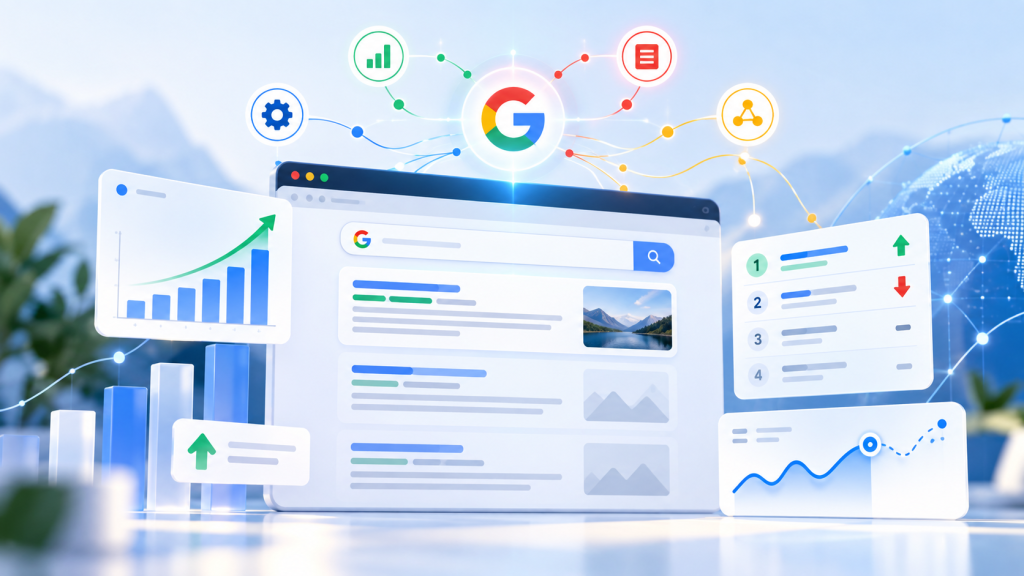
The latest broad Google core algorithm update, the May 2026 core update, is another reminder that search visibility should never be taken for granted. Google began rolling the update out on 21 May 2026 and confirmed that it had completed on 2 June, after just under twelve days of ranking changes across Search.
Core updates are broad changes to Google’s ranking systems. They are not normally aimed at one specific type of website, industry or technical issue. Instead, Google reassesses content and search results across the web as its systems become better at deciding what is relevant, useful and satisfying for a particular search.
For businesses, that means a change in rankings does not automatically mean something is “wrong” with the website. A drop in visibility may happen because Google has re-evaluated other pages and decided they better satisfy a searcher’s needs. Equally, some websites gain visibility because existing content is now assessed more positively against the alternatives competing for the same searches.
Google is re-evaluating the results, not handing every website a new score
Google changes Search constantly. Many changes are relatively small and are never announced. Several times a year, however, Google makes broader changes to systems that are fundamental to how pages are ranked. These are the changes it calls core updates.
The important distinction is that a core update is not normally about one individual ranking factor. There is rarely a useful answer such as “Google now wants 1,500-word pages”, “Google has stopped liking this type of layout” or “every page needs a particular number of internal links”. Search is considerably more complex than that.
Google’s systems assess many signals to determine which results are likely to be most useful for a particular query. A core update changes how parts of those systems work together. When that happens, the relative visibility of competing pages can move even when neither website has made a change during the rollout itself.
That is why reacting to one ranking movement in isolation can be misleading. If a page falls from position three to position six, the first question is not simply what changed on that page. It is also what Google is now showing above it, what those pages offer the searcher and whether the intent behind the search results has changed.
The May update sits within a wider sequence of changes to Search.
Google’s first broad core update of 2026 began on 27 March and completed in early April.
The second broad core update began on 21 May and completed on 2 June after 11 days and 21 hours.
A separate update to Google’s systems for detecting and dealing with spam followed later in June.
Additional spam updates followed in August and September, illustrating how continually Search evolves.
The direction has not changed: create pages that genuinely deserve to satisfy the search
The key takeaway from any core update is the importance of quality. Google continues to reward content that helps users achieve what they came to Search to do. That can sound obvious, but in practice it requires much more than inserting keywords into a page.
A useful page needs to understand the intent behind the search. Someone looking for an answer should receive a clear answer. Someone comparing services should get enough information to make that comparison. Someone considering a purchase should be able to understand the product, its important details, costs or next steps and why they should trust the business offering it.
Google’s guidance describes this as people-first content: content created primarily to be useful to an existing or intended audience, rather than content produced primarily because a search phrase appears to offer ranking potential.
That aligns naturally with good SEO. Search optimisation should help search engines discover, understand and correctly interpret valuable content. It should not be used to manufacture pages that technically mention the right phrases while providing very little additional value.
What matters after a Google core update.
The page should answer the problem behind the query, not merely contain the words that were searched.
Original insight, practical detail, first-hand knowledge and clear explanations create reasons to prefer one result over another.
Clear authorship, real expertise, accurate claims, customer evidence and transparent business information help people trust a page.
Useful information still needs to be accessible through sensible structure, navigation, mobile usability and a strong page experience.
You will often hear this discussion connected to E-E-A-T: experience, expertise, authoritativeness and trustworthiness. It is important not to oversimplify that concept. E-E-A-T is not a single ranking score that can be increased by adding an author box or putting the word “expert” on a page. It is a useful framework for thinking about whether users have good reasons to trust the content and the organisation behind it.
That means expertise needs to be demonstrated rather than declared. Original case studies, detailed service knowledge, accurate product information, specialist commentary, real examples, transparent company information and useful supporting content can all help build a stronger site because they are valuable to users first.
The safest long-term SEO strategy is not to predict the next update. It is to build the kind of website Google would have good reason to keep showing after it.
Start with evidence before changing the website
After an algorithm update, it is important not to react too quickly. During a rollout, rankings can move repeatedly as Google’s systems settle. The May 2026 update has long since completed, so businesses reviewing its impact now have the advantage of being able to analyse the finished period rather than reacting to daily volatility.
The first step is to establish whether a genuine change happened. Use Google Search Console and your own analytics to compare organic visibility, clicks, landing-page sessions, enquiries and sales before and after the update.
Look beyond the total number. A 15% reduction in organic traffic could mean dozens of different things. Did branded search change? Did one high-volume blog article lose rankings? Did commercial service pages decline? Did mobile traffic move while desktop remained stable? Were impressions down, or did click-through rate change because the search results themselves changed?
Commercial outcome matters too. Losing 500 low-intent informational visits is very different from losing visibility to your most profitable service page. Good analysis should therefore connect rankings and Search Console data with what visitors actually do when they arrive.
Move from “traffic changed” to the specific reason it matters.
Compare equivalent periods and establish whether impressions, clicks, rankings or organic conversions genuinely moved.
Segment by landing page, query, device, country, content type, brand and non-brand traffic.
Review what now ranks above you and whether Google appears to be rewarding a different interpretation of the search intent.
Address genuine gaps in content, usefulness, trust, structure, UX or technical quality rather than changing things blindly.
This is an area where combining Search Console with DB Analytics can make the investigation more commercially useful. Ranking data tells you where visibility changed. Analytics can show whether those pages were previously producing meaningful enquiries, sales or customer journeys.
If performance has dropped, assess the page as a user and as a competitor
If you identify specific pages that lost meaningful visibility, review them objectively rather than looking for one technical trick that will restore the previous ranking.
Start with the content itself. Does it still answer the searcher’s current question? Has the information become outdated? Is a competing page more detailed, easier to understand or better supported by first-hand knowledge? Does your page spend too long saying very little before reaching the useful information?
Next, consider trust. Is it obvious who is behind the advice? Does the business demonstrate relevant experience? Are claims supported? Would a first-time visitor understand why they should believe the content? Reviews, case studies, specialist biographies, accreditations and genuine examples can all strengthen trust where they are relevant — but they should be real evidence, not decorative SEO additions.
Then review the overall user experience. A strong piece of content can still be held back commercially by poor navigation, unclear hierarchy, inaccessible mobile layouts, confusing calls to action or a page that makes it difficult for users to complete the next step. SEO and conversion rate optimisation increasingly overlap because both ultimately depend on understanding what the user needs.
Four areas worth examining before deciding what needs to change.
Is it genuinely useful?
Review the page from the perspective of the person who searched, not simply the keyword being targeted.
- Does it satisfy the likely search intent?
- Is important information missing or outdated?
- Does it add anything competitors do not?
- Is the answer clear without unnecessary padding?
Why should someone believe it?
Good information is stronger when the source, experience and evidence behind it are clear.
- Is expertise demonstrated rather than claimed?
- Are authors and businesses clearly identifiable?
- Are there useful examples or case studies?
- Are important claims accurate and supportable?
Is the page easy to use?
Content quality and user experience should reinforce each other rather than compete for attention.
- Is the structure clear on desktop and mobile?
- Can users find the important answer quickly?
- Are internal links genuinely helpful?
- Is the next action obvious?
What is Google preferring instead?
The pages that replaced you are often more informative than speculation about an undocumented ranking factor.
- Has the apparent intent of the results changed?
- Are competitors answering the topic more completely?
- Are different content formats now appearing?
- Do competing pages demonstrate stronger first-hand value?
Do not rebuild successful pages because somebody spotted a pattern in one ranking report
One of the most damaging reactions to a core update is making large, speculative changes without evidence. An update occurs, rankings move, and suddenly old articles are deleted, headings are rewritten, word counts are doubled and perfectly useful sections are removed because somebody has decided Google no longer likes them.
Google’s own guidance advises against this type of quick fix. If a page is useful, accurate and serving its audience well, changing it merely to respond to an assumed algorithm preference can make the page worse.
Meaningful improvement is different. If an audit shows that information is outdated, a page barely answers the query, the navigation is confusing, duplicated pages compete with each other or the website lacks evidence of the experience it claims to have, those are sensible problems to address.
React to evidence, not SEO folklore.
AI makes publishing easier, which makes originality more valuable
There is another important context surrounding modern core updates: the amount of content being published online has increased rapidly. AI tools have made research, drafting, rewriting and content production significantly faster.
Google does not say that content is poor simply because AI was involved in producing it. The important question is why the content exists and whether it provides useful value. Using AI to help organise research, improve a draft or accelerate a legitimate editorial process is very different from automatically publishing thousands of near-identical pages primarily to capture search traffic.
This raises the standard for businesses investing in copywriting and content marketing. Repeating information already available on ten other websites gives Google very little reason to choose yours. First-hand expertise, original examples, industry understanding, useful opinion, proprietary data and clear explanations become more important precisely because generic information is becoming easier to reproduce.
It also means businesses need stronger editorial judgement. AI can help create content, but it should not decide which claims are true, which advice is appropriate for your customers or whether an article genuinely reflects the expertise of the organisation publishing it.
When generic content becomes cheaper to produce, genuine expertise becomes a stronger point of difference.
A strong site needs content, technical quality and a good customer experience working together
Content is central to core-update discussions, but it should not lead businesses to ignore the wider website. Google still needs to be able to crawl, render, understand and index a page correctly. Users still need a website that loads reliably, works on mobile and makes important information accessible.
Internal linking remains valuable because it helps visitors discover related information and helps search engines understand the relationships between important pages. The objective is not to insert as many keyword-rich links as possible. Good internal linking should make the website easier to navigate.
The same applies to website design. A visually impressive site is not automatically good for SEO, but neither is a page of technically optimised text that is unpleasant to use. The strongest websites align search intent, information architecture, brand credibility, performance and conversion into one coherent experience.
That is why a fall in organic performance sometimes needs a broader response than editing a paragraph. The real opportunity might sit in navigation, page structure, product information, content duplication, conversion friction or the way an entire service area has been organised.
Improving a page does not guarantee an immediate return to its old position
One of the more difficult aspects of core updates is that improvement and recovery are not instantaneous. Search rankings are comparative and dynamic. You can improve your own page while competitors are improving theirs, search behaviour is changing and Google’s systems are continuing to evolve.
Google says some improvements may be reflected within days, while broader assessments can take several months. Crucially, website owners do not necessarily have to wait for the next named core update. Google also makes smaller ongoing changes to its core ranking systems that are not individually announced.
There is also no guarantee that a page will return to exactly the position it held before. The correct objective is not to recreate an old ranking screenshot. It is to improve the page and the wider website so that they continue to deserve visibility as the market and search results develop.
That makes ongoing measurement important. Use Search Console to monitor visibility, but connect that information to enquiries, sales and other commercial outcomes. Ranking first for a phrase is useful only if the phrase attracts the right audience and contributes to the purpose of the website.
Do not build a website that survives one Google update. Build one that keeps giving Google a reason to show it.
The May 2026 core update does not require businesses to discover a hidden trick. It reinforces a direction Google has communicated for years: create useful content for real users, demonstrate genuine knowledge, maintain a technically sound website and keep improving the experience as your customers and market change.
For businesses reviewing ranking movements, Google’s own documentation is the most useful starting point. It explains what core updates are, how Google recommends assessing affected pages and how people-first content fits into its wider approach to Search.